
The European Commission’s Communication on the European Sport Model recognises the importance of athletes’ rights, the role of athletes’ associations as partners in the governance of sport and the need to strengthen social dialogue across European sport.
The European Athletes and Players Association (EAPA), alongside the global and European federations of athletes’ unions and the World Players Association (WPA), welcomes the European Commission’s Communication, Reinforcing the European Sport Model.
Further, we appreciate the opportunity to have contributed feedback to Commissioner Glenn Micallef, his team and the European Commission’s Sport Unit during its development. As the Communication notes, sport governance is often global and European sport standards have international reach, so its impact matters for athletes worldwide.
We believe three elements are of significance to EAPA members: (1) the recognition of athletes as workers; (2) the role of athletes’ associations as social partners in the governance of sport, and (3) the commitment to developing social dialogue in sport.
Athletes as workers
The Communication cites the newly approved ILO Guidelines for professional athletes. The Guidelines cover professional athletes and athletes in high-level sport. They protect them through the ILO’s Fundamental Principles and Rights at Work, including freedom of association and collective bargaining, regardless of how their employment is classified.
WPA and EAPA recognises only two groups of athletes: recreational athletes and working athletes. Working athletes compete in high-level sport, or train intensively to reach it, where sport organisations have a financial interest in their performance. Whether they are workers depends on the economic reality of the relationship, not on how sport bodies label it. Women athletes are particularly at risk of having their work mislabeled as “amateur” and being denied their rights under EU and national law.
Athletes’ associations in the governance of sport
The Communication also explicitly names athletes’ associations as partners of sport governing bodies. Decisions taken by sport governing bodies shape athletes’ working lives, from competition calendars to disciplinary rules.
The Communication states:
“They exercise regulatory, organisational and disciplinary functions. These functions should be exercised responsibly, together with leagues, clubs, athletes’ associations, and supporters’ organisations […]”
Social dialogue in sport
Social dialogue is one of the foundations of the European social model, and sport should be no exception. Today, European social dialogue in sport exists only in professional football. As such, EAPA particularly welcomes the Commission’s commitment to its development.
The Communication states:
“develop social dialogue in sport, including through financial support, to build and strengthen the representativeness and capacity of sport social partners, beyond professional football.”
Extending social dialogue to other sports, with financial support, and tying it to the definition of “responsible autonomy” would allow athletes in more disciplines to negotiate their working conditions collectively with athletes’ associations working on their behalf towards a more equitable and sustainable future
Wider Commitments
Women athletes cannot be left behind
Women athletes are most at risk of having their work mislabeled, leaving many outside EU protections on equal pay and maternity rights. While the Communication lists equality among the values of the European Sport Model, the ILO Guidelines set out what it means in practice for women athletes: equal terms and conditions, equal pay for work of equal value, transparency in how resources are allocated between men’s and women’s sport, and maternity protection, including the right to return to sport (paras 65–73). Governing bodies should apply these standards, and the Communication’s implementation is the opportunity to turn a commitment into meaningful protections.
Competition calendars and workload
The Communication acknowledges that commercially driven decisions are “adding to pressures on athletes and competition calendars”. This is an increasingly pressing issue for athletes’ physical and mental health.
Revenue distribution
Athletes are named among those concerned by the need for greater transparency on how financial resources are generated, allocated and redistributed in sport. The Commission will launch a study on financial distribution mechanisms in sport (Q1 2027).
Safe sport
The Commission will set up a High-Level Group on safeguarding people in sport (Q3 2027), with a view to proposing common safeguarding guidelines for sport organisations.
EAPA welcomes these developments and, in particular, the recognition of athletes’ associations and the importance of their involvement in shaping the future of European sport. However, recognition must be accompanied by meaningful representation in decision-making.
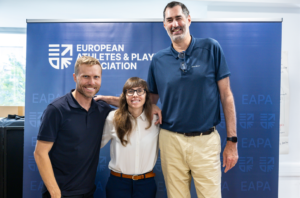
Natalia Orive, EAPA President, said: “Athletes’ associations must play a greater role in decision-making, and we welcome the Communication’s recognition that athlete representation needs to be strengthened. EAPA will keep working for the recognition and protection of athletes’ rights, by promoting minimum standards for working conditions and collective bargaining agreements. Recognising athletes’ rights goes hand in hand with strengthening social dialogue and extending it to more sports. Sport is strongest when athletes have stable, decent conditions, and we will keep working to make sure their voice is heard in sport governing bodies, federations and leagues.”
Walter Palmer, Executive Director of the WPA, said “The Commission has pointed European sport toward the ILO’s Fundamental Principles and Rights at Work. Now Member States must follow through. Responsible autonomy does not let sport bodies write their own labour law, and athletes do not leave their rights as citizens or workers at the door when they participate in sport. Social dialogue and collective bargaining are how sport earns accountability, transparency and legal stability. Europe’s standards often shape sport around the world, so getting this right in Brussels matters for athletes from LA to Brisbane.”
EAPA and WPA will continue its engagement with the European Commission, alongside FIFPRO Europe and other partners to help turn these commitments into meaningful progress for athletes and players across Europe through minimum standards, social dialogue and collective bargaining.