Jan 14, 2020
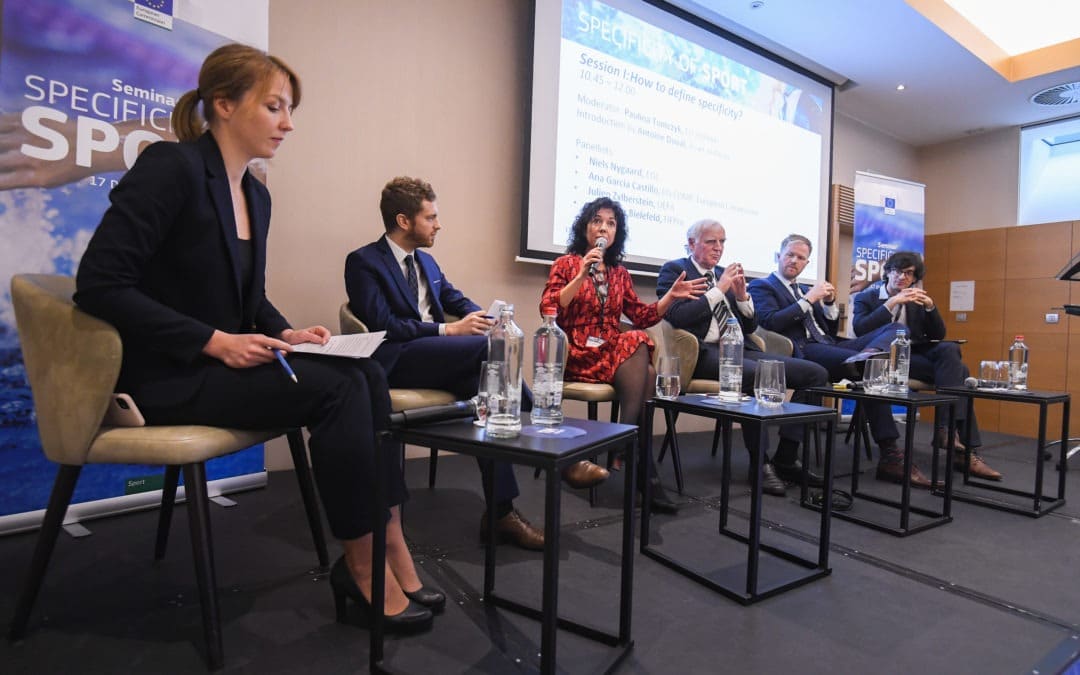
EU Athletes took part in the Seminar about “Specificity of Sport”, organized by the European Commission on the 17th of December. The productive day was organized in three different panels about the definition of specificity of sport, how national institutions are taking it into account and how should it be protected.
no need to describe this panel, better to say generally who was taking part, what kind of organizations, how many participants etc
In the first panel, which theme theme was “How to define specificity?”, EU Athletes joined the discussion with Antoine Duval (asser Institute), Niels Nygaard (Vice President of EOC), Ana Garcia Castillo (DG COMP, European Commission), Julien Zylberstein (UEFA) and Alexander Bielefeld (FIFPro). The interesting exchange of opinions from different stakeholders in the sport industry has been very stimulating and engaging, raising many questions from the audience.
EU Athletes, as representative of professional players, remarks that, whenever the principle of specificity of sport is applied, the rights and the interests of the athletes must be considered and protected in order to take fair and equal decisions for them.

Jan 9, 2020
Following the developments related to the modification of the Olympic Charter’s Bye-law 3 to Rule 40 (Rule 40) and inquiries about its incompatibility with the European Union (EU) law, we would like to underline our opposition to the above-mentioned rule, emphasize our support for the European Commission for protecting athletes’ rights against the abuse and express an openness to a dialogue and negotiations on this matter.
Athletes that we represent are among those that are obliged to comply with Rule 40 in order to compete at the Olympic Games. Following the German Bundeskartellamt ruling earlier this year, it is increasingly clear the Olympic Rule 40 is in breach of the EU competition law. Despite the recent changes, Rule 40 remains unduly restrictive of athletes’ economic rights and their commercial opportunities.
We are strongly of the opinion that Rule 40’s continued excessive restrictions are a result of the flawed decision-making process within the Olympic movement. Independent athlete associations, who do not support Rule 40, were excluded from the process. Mere consultation of athlete commissions, which are a part of the Olympic movement themselves, is unacceptable when it comes to rules that affect all athletes participating at the Olympic Games. By choosing to ignore independent athlete associations, the IOC’s approach is not compatible with the principles of good governance and the fundamental right of freedom of representation.
While the IOC indicates that the athletes should negotiate directly with their National Olympic Committees (NOCs), it is apparent to EU Athletes, and probably the European Commission, that it is Rule 40 itself that is under question as a source of infringement of athletes’ rights. IOC, as the leader of the Olympic Movement and organizer of the Olympic Games, must assure that the athletes’ rights are respected in this context. At the same time, the European Commission has a responsibility to help protect the economic rights of European athletes and is uniquely placed to do so by ensuring that sport organizations comply with EU competition law. It is unacceptable for sport organisations to abuse their dominant positions to pursue their own commercial interests to the detriment of the rights of athletes.
From our side, EU Athletes is committed to advancing the rights of the athletes in Europe and is committed to discussion and negotiation in order to reach a long-term solution that is compatible with the EU law and fundamental rights as well as the interests of the stakeholders.
Dec 13, 2019
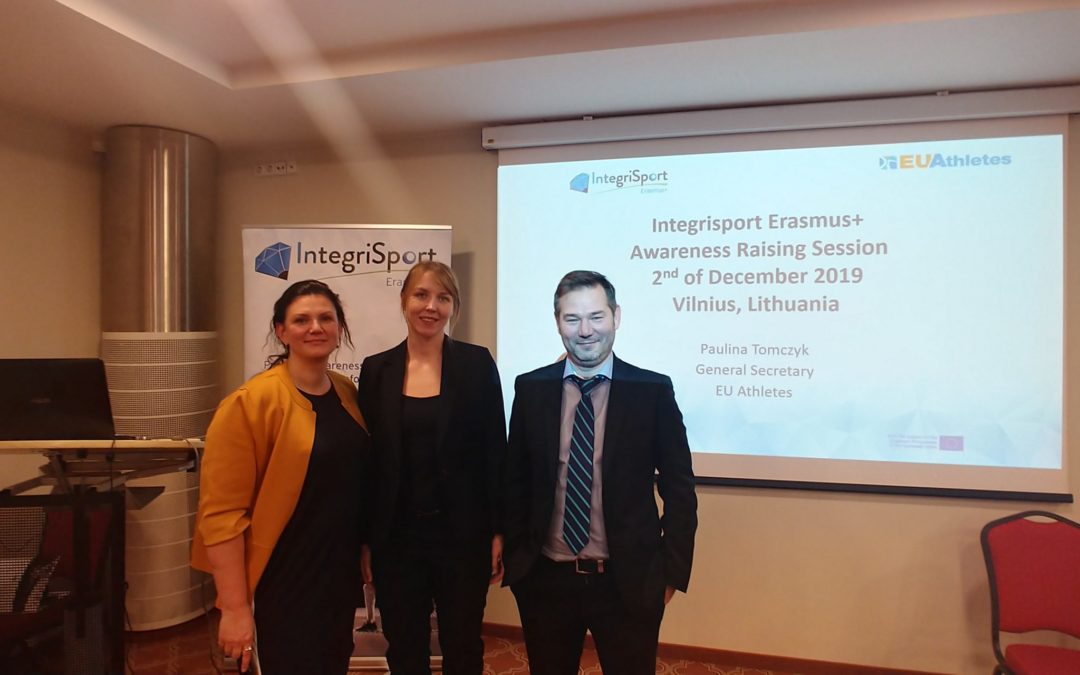
The third awareness raising session on combating sport manipulation and match fixing, within the framework of EU-financed Project Integrisport Erasmus+, was held in Vilnius, Lithuania, between 2-4 December. It was co-organized by the Ministry of Education, Science and Sport and the Lithuanian Sport Centre, together with CSCF-Foundation for Sport Integrity.
The productive debate was an occasion to discuss, with the representatives of Lithuanian Law Enforcement and Judiciary, the problematics concerning sport manipulation and match fixing, providing them with insights and recommendations to face and combat this spreading issue.
As representative of players, EU Athletes has been called on stage to share the perspective of the athletes and the work that, alongside its members, is carrying on to fight against match fixing. PROtect Integrity, the project founded by the Erasmus+ Programme of the European Union, was presented to the audience, depicting the key aspects and benefits for the professional athletes, including the player=led Red Button reporting App.
The Integrisport Erasmus+ awareness raising sessions provide the local law and juridical enforcement with a better knowledge and comprehension about the dangers of sport manipulation on society.
The next session will take place in Helsinki in February 2020.
Dec 11, 2019
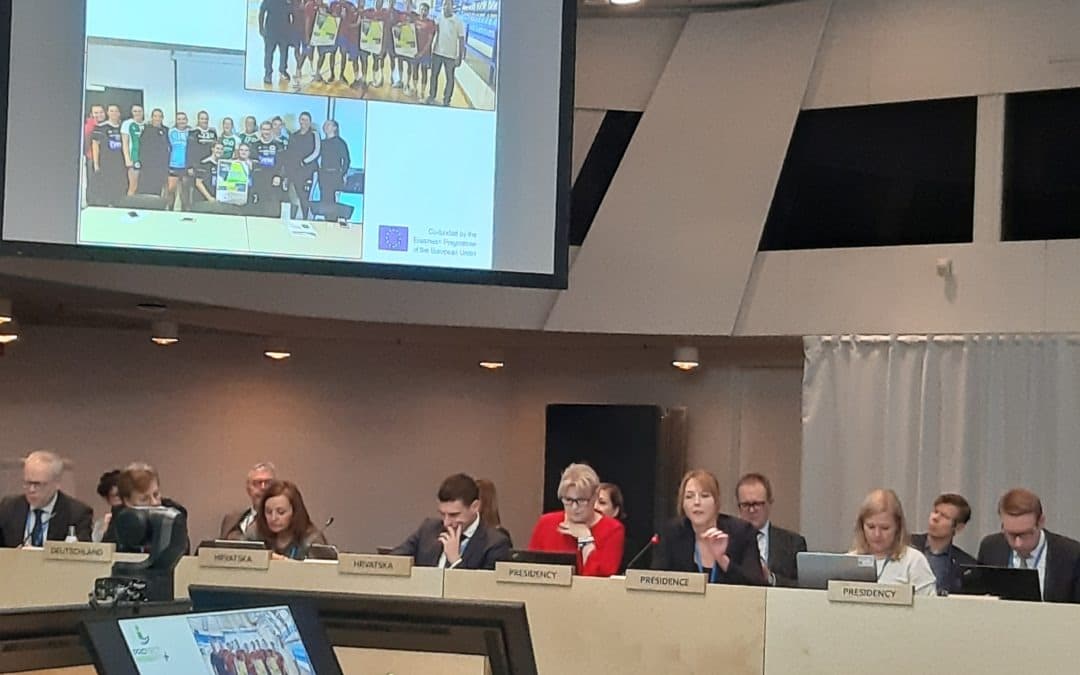
A meeting of Directors General for Sport took place on 9-10th of December in Helsinki. Corruption in sport was one of the main topics addressed by the Finnish Presidency, and the discussions came very timely after the adoption of the Council Conclusions on combating corruption in sport. EU Athletes was invited to take part in the debate as a part of the structured dialogue with the sport movement, in order to present the athletes perspective and the work done by the player unions when it comes to fighting corruption in sport. EU Athletes General Secretary Paulina Tomczyk presented the Erasmus+ PROtect Integrity Plus project and the Red Button Reporting App that contributes to the prevention and detection of sport manipulations. She also emphasized on the need to address corruption holistically, focusing on the need to improve the governance of sport organizations and protect the athletes’ rights.
Nov 8, 2019
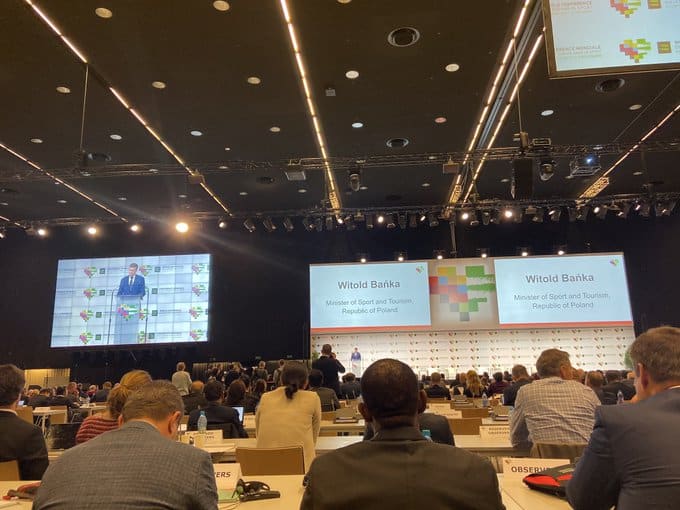
The event took part in Katowice, Poland on 5-7th of November and gathered around 1500 participants. The Conference and the accompanying meetings of WADA Executive Committee and the Foundation Board were an opportunity to approve the new International Standards as well as the 2021 World Anti Doping Code. Regarding the substantial changes, EU Athletes is pleased to see a new article 10.2.4 on Substance of Abuse, which is a step in the right direction regarding the health and welfare of players, an approach that player unions have been advocating for many years.
The new WADA President Witold Banka and vice-President Yang Yang were also officially appointed in Katowice to start their work in the new respective roles next year. Both Mr Bank and Ms Yang participated in the informal meeting with athlete representatives, including EU Athletes and World Players Association.
For Paulina Tomczyk, EU Athletes General Secretary: ‘We appreciate this approach and count for further dialogue as more work is needed in order to make sure that the anti-doping system is fair, proportionate and respects the rights of players. Athletes need to be able to take part in creation of the rules that affect them and importantly, to be represented by the people of their own chosing in that process.’
For further information, EU Athletes’ members common position on anti-doping can be found here.
Oct 18, 2019
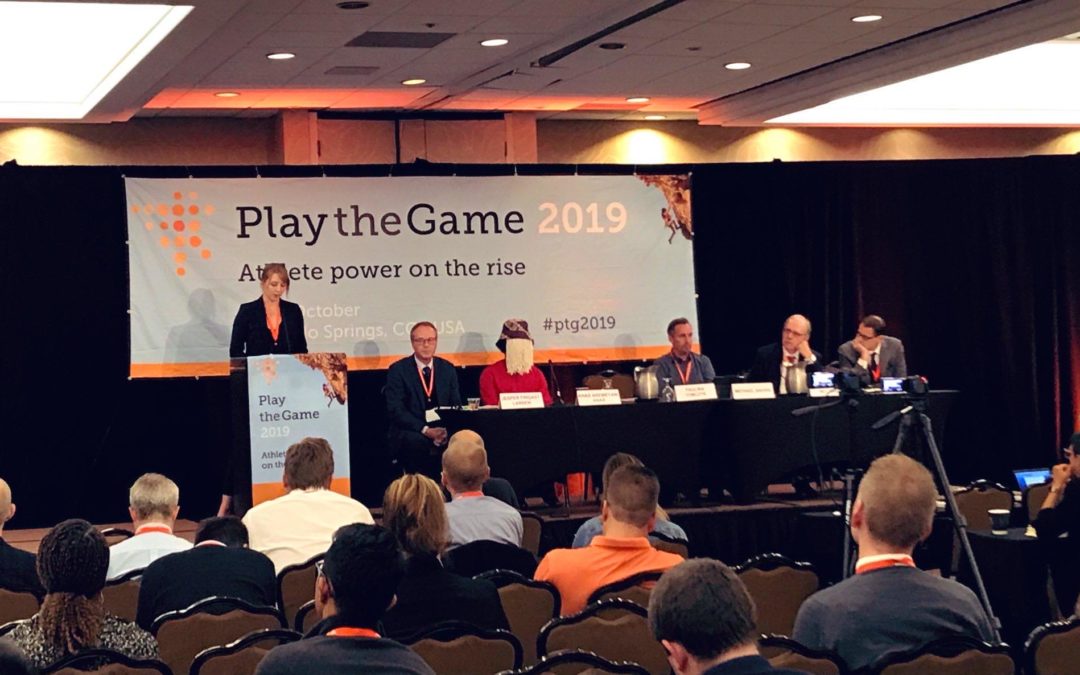
For the first time hosted outside Europe, Play the Game took place in Colorado Springs 13-16th of October 2019. With over 300 participants, the Conference provided a venue for inspiring debates on the most topical themes in the world of sport with the conference’s main theme: Athlete power on the rise. Play the Game 2019 also took on classic themes like doping, whistleblowing, match-fixing, corruption, but also one of the most discussed topics in the U.S., elite sport and college education, will be at centre stage during the conference.
The host city of Play the Game 2019 has a prominent position in U.S. sport and is also an Olympic City USA. The city also hosts the main Olympic and Paralympic Training Center along with over 25 national sports federations plus the U.S. Anti-Doping Agency and United States Olympic Committee.
For Paulina Tomczyk, EU Athletes General Secretary who was involved in the organization of the Conference as a member of Programme Committee: ‘Athletes are increasingly standing up for their rights and want to work in partnership with sport to develop in a way which will benefit all stakeholders. Athletes’ power is an essential factor to go forward and as the representative of independent player unions and associations, I am happy to share the model that have already been a part of such positive developments in many professional and elite level sports.’
More information on the event can be found on the website. Videos from conference sessions are available on Play the Game YouTube channel.
